
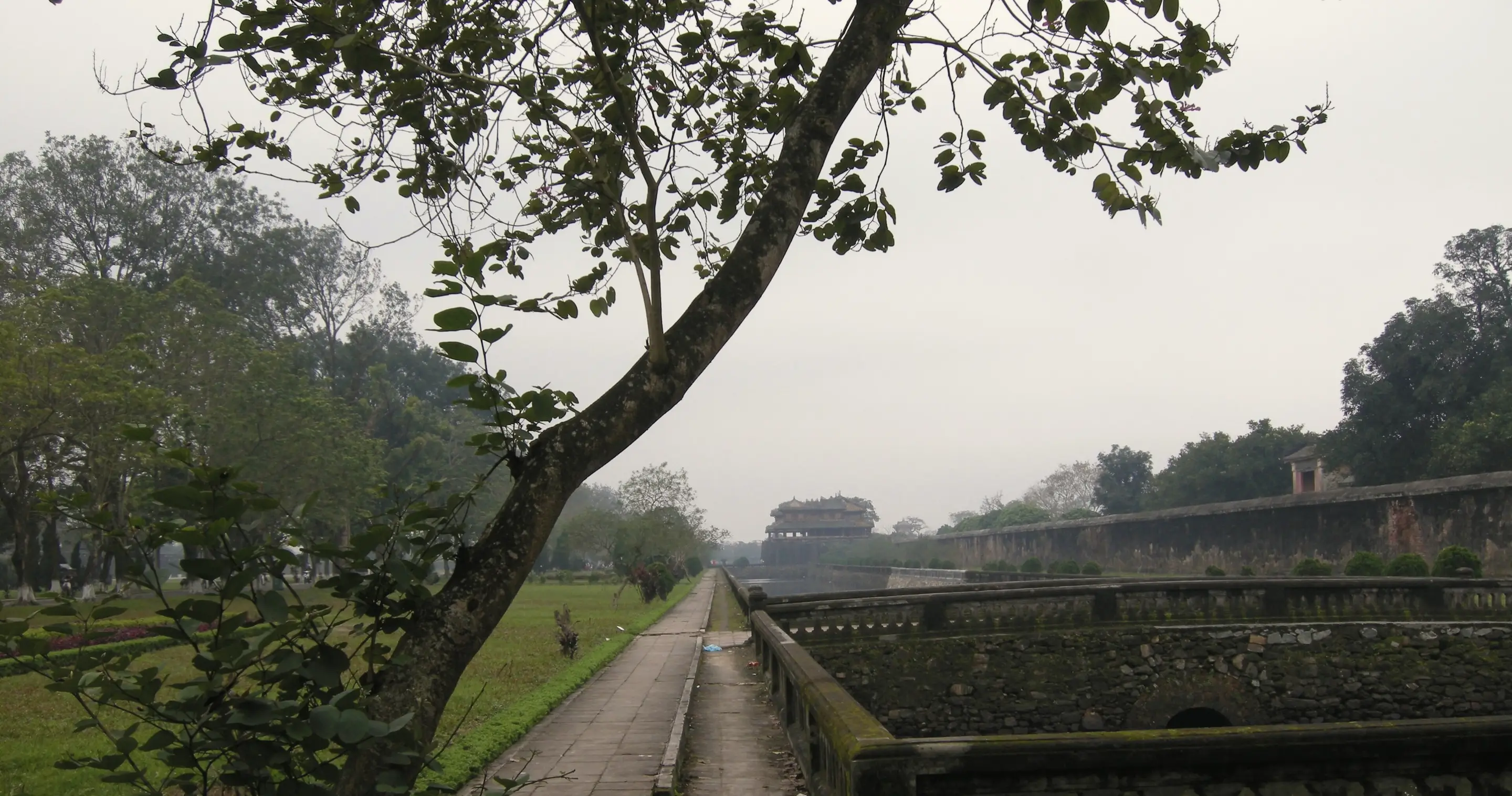
Hue was the capital of Vietnam under the Nguyen dynasty from 1802 to 1945. The emperors built a citadel on the north bank of the Perfume River, with moats, ramparts and, at its heart, the Imperial City and the Forbidden Purple City, where only the royal family and their servants could enter.
Much was lost to war in the twentieth century, but restoration has brought back gates, halls and gardens. Walking through the Ngo Mon Gate in the morning, before the groups arrive, gives a sense of the ceremony this place was built for: courtyards scaled for processions, dragons on every roof ridge, and lotus ponds reflecting red lacquered pavilions.
Beyond the citadel, the emperors chose their own resting places among the hills along the river. The tombs of Minh Mang, Tu Duc and Khai Dinh are each a world of their own: one symmetrical and serene, one a poet's garden with a lake and pavilions, one a surprising blend of Vietnamese and European styles.
Hue is also a city of food and faith. Royal cuisine was refined here into many small, delicate dishes, and the seven-storey Thien Mu Pagoda still watches over the river. We often travel to it by dragon boat in the late afternoon, as the light softens over the water.