
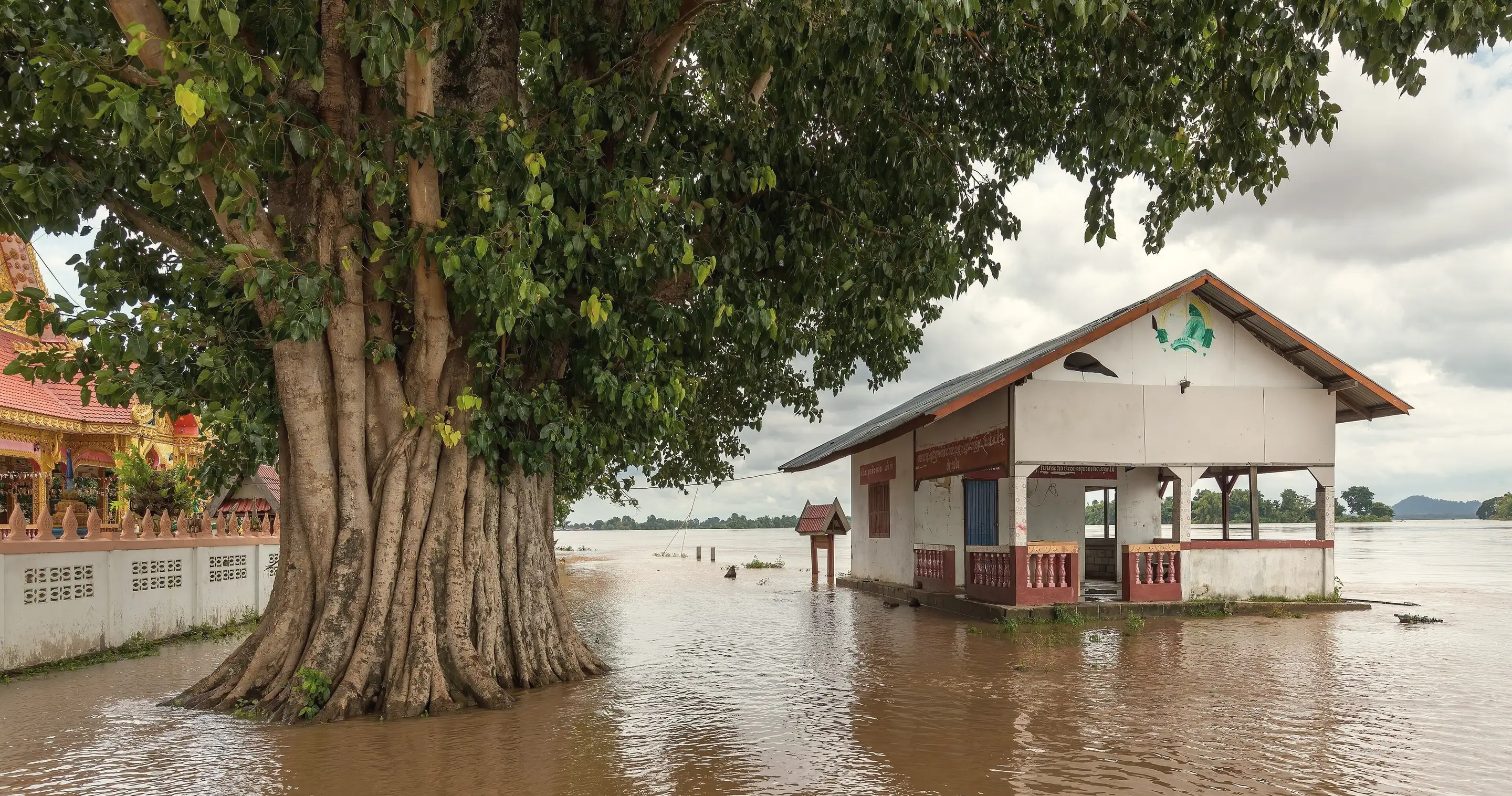
Just before the Cambodian border, the Mekong widens to as much as fourteen kilometres across. In the dry season, as the water drops, hundreds of islands and sandbars appear, which is why the Lao call this area Si Phan Don, the Four Thousand Islands. Some are large enough for villages and rice fields; many are no more than a tree on a rock.
Life on the inhabited islands moves at the pace of the river. On Don Khone and Don Det, a former French railway bridge now carries bicycles rather than trains. We cycle along shaded paths between villages, past rice fields and buffalo, with frequent stops at riverside cafés.
The Mekong here is broken by a series of rapids and falls. Khone Phapheng is the largest waterfall by volume in Southeast Asia, a wide wall of white water that made the river impossible to navigate and shaped the history of the region. Nearby, the gentler Li Phi falls are said to trap bad spirits as they pass.
In the late afternoon, we take a long-tail boat out onto the open river. The deep pools below the falls were long home to Irrawaddy dolphins; the last of them disappeared from this stretch of the river in recent years, a reminder of how fragile the Mekong is. The river at sunset, golden and wide, is still reason enough to come.